- AI-First Business by Jeff Sauer
- Posts
- The agent stuff is real (but not for everyone yet)
The agent stuff is real (but not for everyone yet)

Jeff Sauer
December 20, 2025
Four AI agent services worth watching
I've been doing the deep research I promised.
Today I want to share what I'm seeing around AI agents. The real picture, not the hype.
Where we actually are
First, let's be honest about the adoption curve.
You know that innovation curve? Innovators, early adopters, early majority, late majority, laggards?
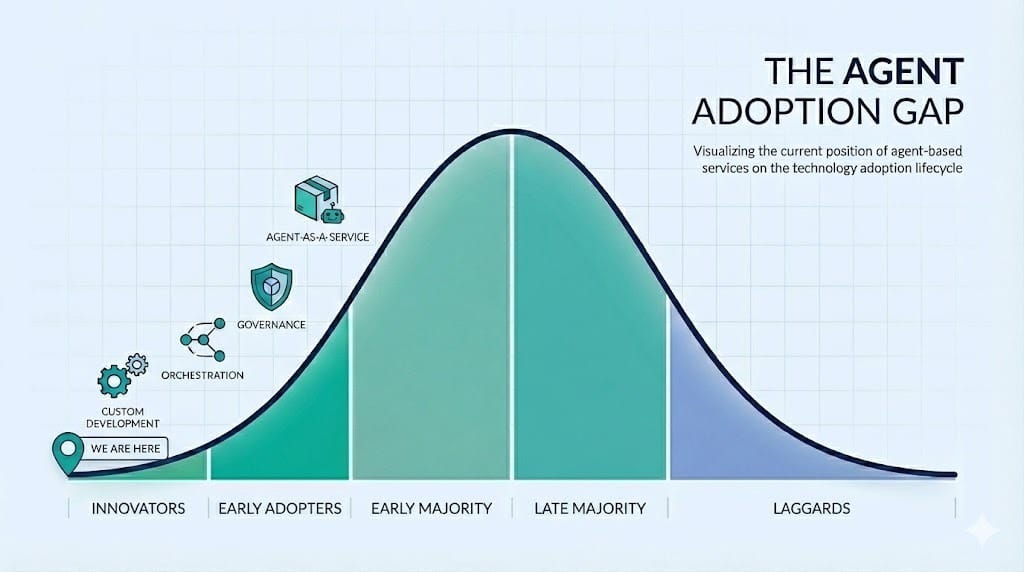
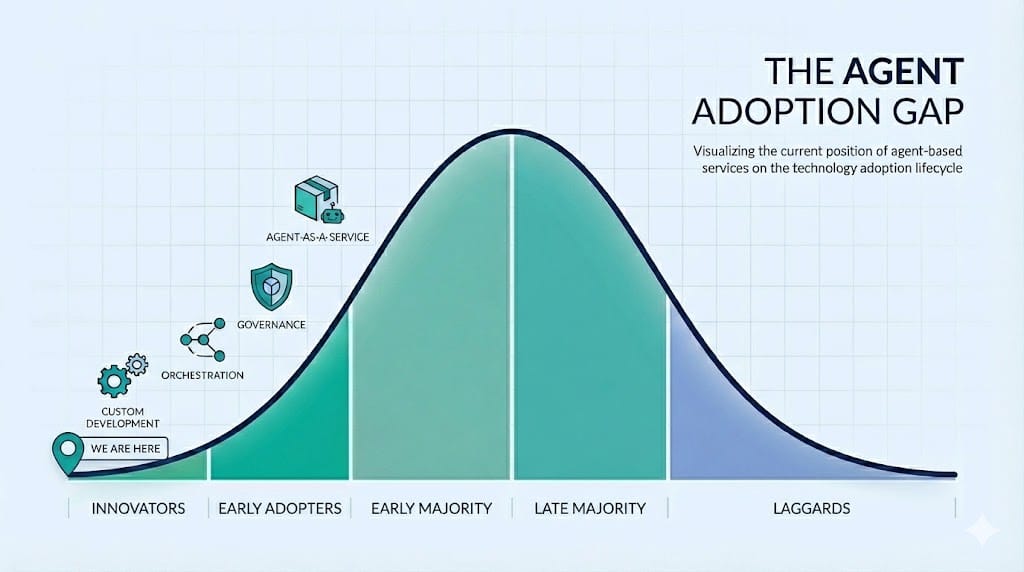
The stuff I'm about to share? This is innovator territory. Maybe bleeding into early adopter.
We're not at early majority yet. Not even close.
So if you're reading this thinking "my clients aren't asking for this"—yeah, most of them aren't. And that's fine. That's actually the point.
The shift from generative to agentic
2024 was about generative AI. Creating text, making images, that sort of thing.
2026 is going to be about agentic AI. Actually executing tasks and workflows.
The difference is huge.
Generative AI needs a pilot. Someone to prompt it, guide it, check its work.
Agentic AI needs an architect. Someone to design the system, set the guardrails, and orchestrate how it all works together.
That's where the interesting services are emerging.
Four services that are actually happening
Let me walk through what I'm seeing. Keep in mind—this is for the innovators right now. The businesses that are willing to be first, to work through the mess, to figure out the business model while the technology is still being proven out.
1. Custom AI Agent Development
This is the "agent factory" model.
Agencies are building bespoke agents for clients. Not chatbots. Actual software systems that can reason through problems.
Customer service agents that handle support tickets without human intervention. Operations agents that monitor inventory and automatically adjust ad spend when stock runs low.
The barrier to entry has actually lowered—platforms like Salesforce Agentforce and Google Agent Builder exist now. But the complexity of configuration has spiked.
Clients need someone to be the systems integrator. To customize the logic, set the tone, build the guardrails.
The margins are high because it's sticky. Once you build the sales agent that drives 30% of a client's revenue, they can't easily switch vendors.
2. Agent Orchestration
Here's what's starting to happen: businesses buy different agents from different vendors. A sales bot here, a support bot there.
Then they realize none of these things talk to each other.
The retention agent is offering discounts to customers the sales agent just upsold at full price. The data doesn't sync. Nobody knows what the bots are actually doing.
The service opportunity is becoming the "general contractor" for a client's AI ecosystem.
Building the middleware so all agents share the same memory of the customer. Making sure they don't contradict each other. Reporting on agent performance the same way you'd report on ad performance.
3. AI Governance and Red Teaming
The fear of rogue AI is real for enterprise clients.
One hallucination where the bot promises something insane or says something offensive? Brand reputation destroyed.
So agencies are launching AI governance practices that work like cybersecurity firms.
Red teaming—intentionally trying to break the bot before it goes live. Compliance audits to make sure it meets regulations like the EU AI Act. Bias mitigation to ensure it's not discriminating in its decision-making.
This is premium, recurring revenue. Assurance retainers.
4. Agent-as-a-Service
The smartest play I'm seeing: agencies building their own agents and licensing them.
Instead of building a custom agent for every real estate client, you build one really good real estate agent. Train it on millions of conversations. Then license it to brokerages for monthly fees plus success fees per appointment booked.
The moat isn't the software—that's getting commoditized. The moat is the proprietary data you used to train it.
If you've been running real estate ads for 10 years, you have the chat logs to train the best agent. That's defensible IP.
The reality check
Look, I think the pace of AI technology is going to support all of this in 2026.
But the guardrails? The business models? That stuff is still being figured out.
This is going to be a 2026 thing for the innovators. The businesses willing to be first, to experiment, to deal with the messiness.
Most businesses aren't there yet. And that's okay.
But if you're positioned to work with innovators, or if you want to be one yourself? This is where the interesting work is happening.
Next newsletter I'll talk about services that are further along the adoption curve. Things that are actually hitting early majority right now.
But I wanted to start here because this is where the frontier is. This is what's being built while everyone else is still debating whether AI is going to take our jobs.
To Your AI-First Success,
Jeff Sauer

Your readers want great content. You want growth and revenue. beehiiv gives you both. With stunning posts, a website that actually converts, and every monetization tool already baked in, beehiiv is the all-in-one platform for builders. Get started for free, no credit card required.