- AI-First Business by Jeff Sauer
- Posts
- Early majority, next 24 months
Early majority, next 24 months

Jeff Sauer
December 27, 2025
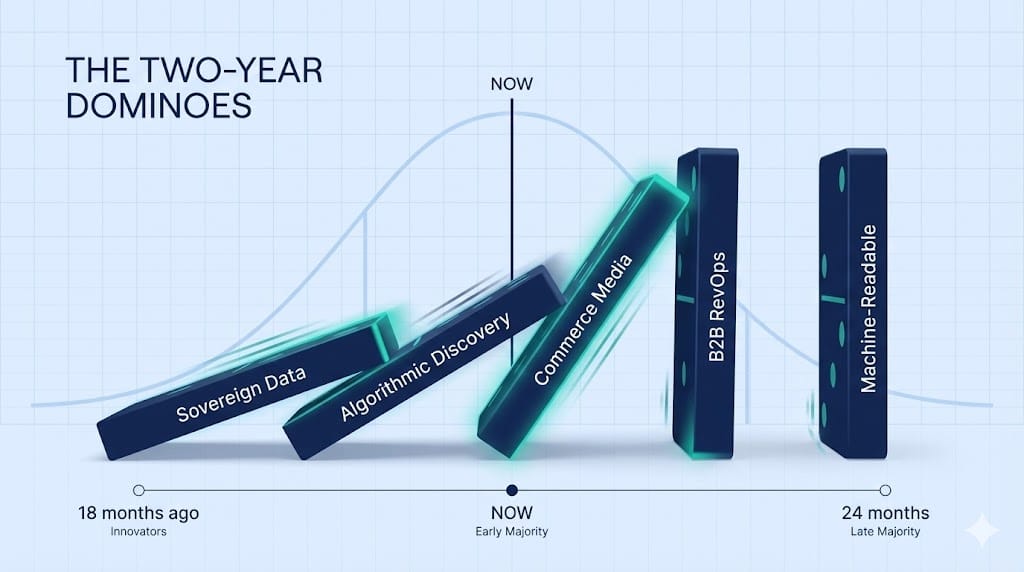
The adoption curve is accelerating
Last week, I shared the innovator stuff - AI agents, orchestration, governance.
Today I want to talk about what's already tipping.
The things that are moving from "early adopter edge case" to "early majority standard practice" right now. The two-year dominoes that are already falling.
Where the adoption curve is accelerating
The research is showing something interesting.
There's a cluster of capabilities that were experimental 18 months ago, are being adopted by early majority businesses right now, and will be table stakes for the late majority within 24 months.
These aren't the bleeding-edge innovator plays anymore. These are the things your clients will start to expect as baseline competency.
I'm seeing five major categories where this shift is happening.
1. Sovereign data infrastructure
The signal crisis is real.
Browser restrictions, privacy laws, iOS settings - they're stripping away 30-50% of conversion data before it ever reaches ad platforms.
Server-side tracking isn't a nice-to-have anymore. It's becoming the standard.
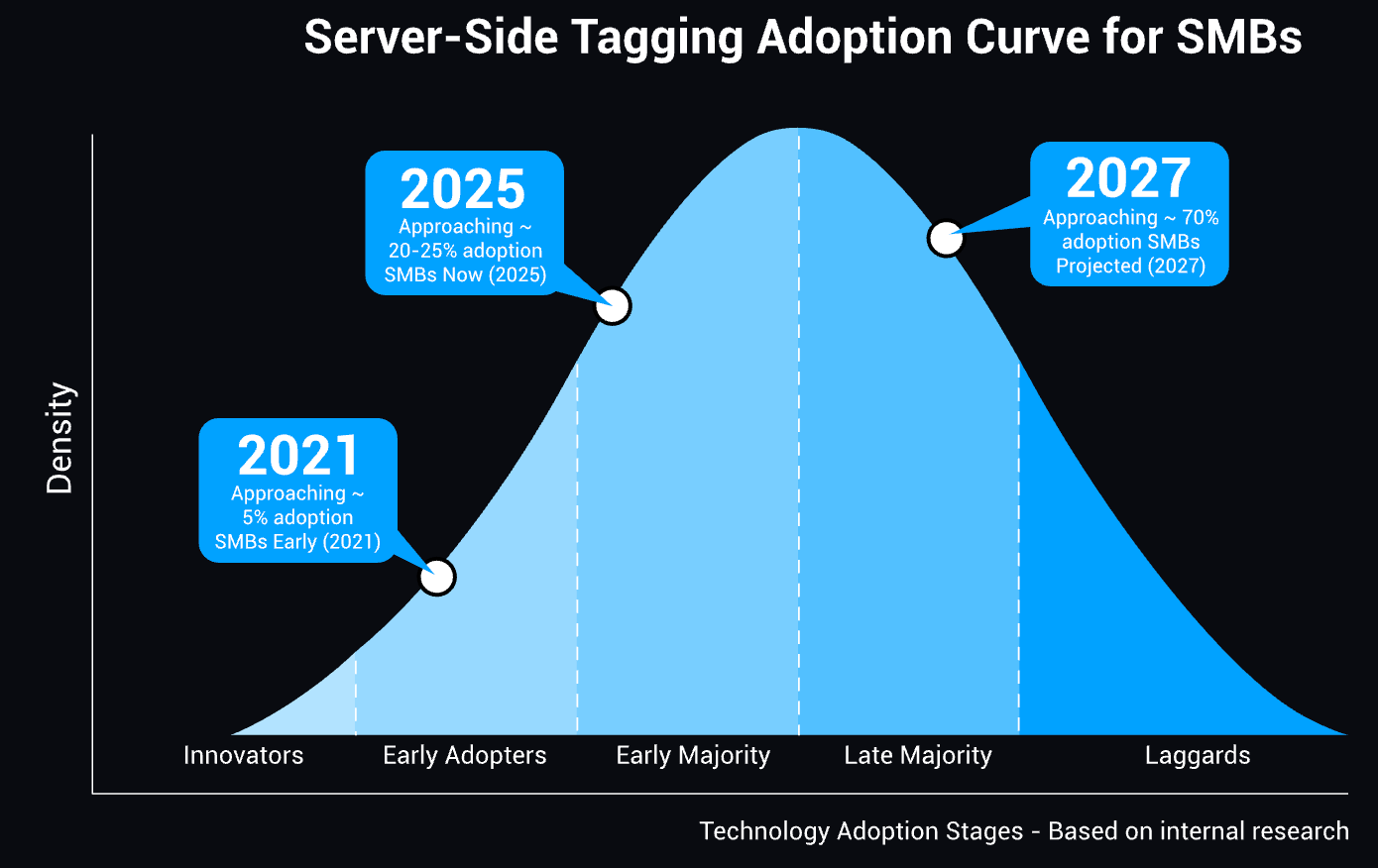
Usercentrics released the graph above that tells us everything we need to know about this growth!
The DACH region (Germany, Austria, Switzerland) led adoption because of GDPR. But the US is waking up fast. There's a massive window right now to migrate mid-market clients to proper server-side setups.
The pitch is simple: "You're losing 30% of your conversions. We can recover them."
Beyond tracking, there's the whole consent architecture piece. Not just cookie banners - actual compliance infrastructure that handles the patchwork of state laws, respects browser signals, optimizes consent rates within legal bounds.
And data clean rooms are becoming the standard for brand collaboration now that third-party cookies are dead. Brands need ways to match their data with partners' data securely. Someone has to operate those rooms.
2. Algorithmic discovery optimization
Search is changing.
People are searching via AI now. ChatGPT Search, Google AI Overviews, Perplexity.
The goal isn't getting a click to your website anymore. It's getting cited in the AI's answer.
This means entity management - making sure the brand is recognized in knowledge graphs. Citation engineering - getting mentioned in the high-authority sources that LLMs trust. Zero-click content strategies designed for bots to scrape and summarize.
It's not SEO anymore. It's AEO - Answer Engine Optimization.
And on the testing side, synthetic users are becoming real. Instead of waiting weeks for live traffic to reach statistical significance, agencies are running thousands of AI-generated personas through landing pages to predict conversion rates before anything goes live.
Visual search is accelerating, too. Product imagery needs to be optimized for computer vision models, not just human eyes.
3. Commerce media fragmentation
Retail Media Networks are rivaling social media in ad spend.
But the ecosystem is fragmented. Every retailer has their own network. Amazon, Walmart, Target, Marriott, Uber, Chase - they all have ad platforms now.
Brands can't manage 50 different logins.
The service opportunity is aggregation and orchestration. Using platforms to buy across multiple RMNs simultaneously, with real-time budget allocation based on inventory and profitability.
There's also this emerging thing around agentic commerce - optimizing product data so AI agents can read it when making purchase decisions on behalf of humans. If someone tells their AI "buy me the most sustainable laundry detergent," your sustainability data needs to be accessible via API.
4. B2B revenue operations convergence
The old B2B playbook is dying.
Gated ebooks, form fills, cold calls - buyers are resistant to all of it. They're staying anonymous longer, doing their own research, avoiding sales conversations until they're ready.
The response is agentic ABM. AI SDRs that research prospects, draft personalized outreach, handle objections. De-anonymization tech that identifies website visitors and triggers outreach only when high intent is signaled.
And unified RevOps - connecting marketing automation to CRM to create closed-loop attribution where marketing gets credited for revenue, not just clicks.
Clients don't want leads anymore. They want revenue.
5. Machine-readable everything
This one cuts across all the others.
Whether it's data clean rooms, AI citations, agentic commerce, or synthetic testing - the pattern is the same.
Everything needs to be structured for machines to read, not just humans.
Schema markup. Structured data. API-accessible product attributes. Machine-readable sustainability claims.
The businesses that structure their data for algorithmic consumption are going to win discovery, win testing cycles, win AI-mediated purchases.
The two-year timeline
Here's what makes this different from the agent stuff I talked about last week.
These aren't experiments. These are already being adopted by early majority businesses.
The innovators did this 24-36 months ago. The early adopters are doing it now. The early majority is going to do it in the next 12-24 months.
Which means if you're an agency or consultant, you've got about two years before this stuff is table stakes. Before clients expect you to already know how to do it.
That's the window.
Not to become an expert in everything. But to understand the landscape well enough to know where to place your bets, what to build competency in, and what to partner for.
The research is revealing clear patterns. The adoption curve is accelerating.
The dominoes are already falling.
To Your AI-First Success,
Jeff Sauer
Get Your Content Ops Workflows Right in 2026 - Best Practices
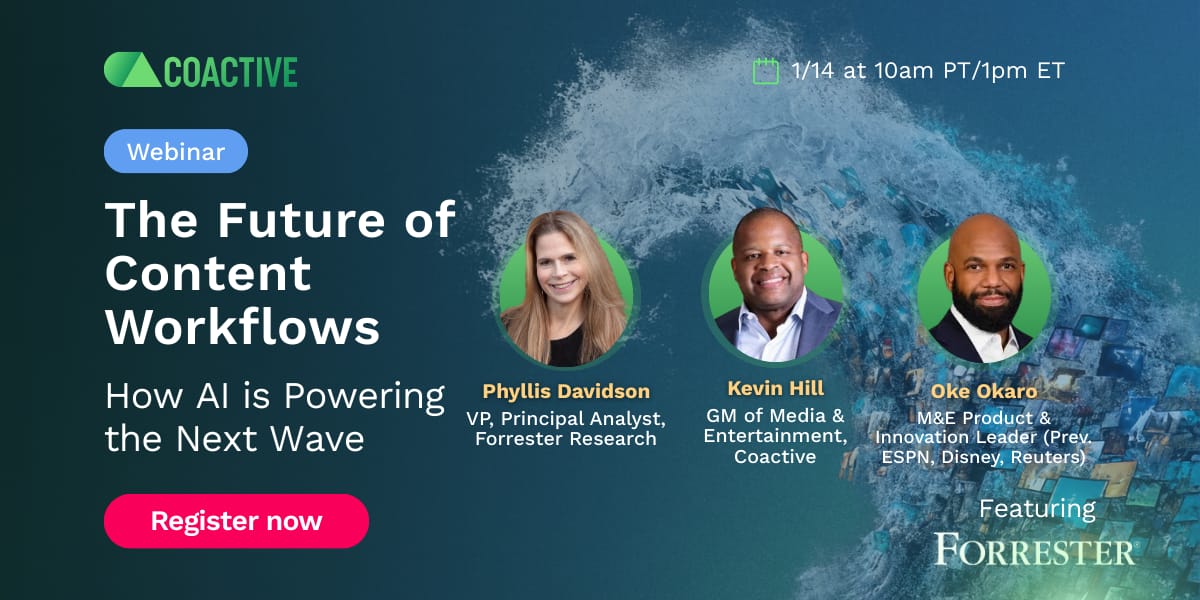
Want to manage and monetize your content to the fullest in 2026?
Join Forrester Research and media execs with experience spanning ESPN, Comcast, and Disney on January 14, 2026, at 10am PT/1pm ET.
Get actionable insights and perspectives from the leaders who built and transformed top media and entertainment organizations.